







CLICK HERE TO BUY DISPLAY CASE
Thomas Sherrin didn't set out to invent anything. He was just a leather worker running a small Collingwood workshop in 1880, handed a busted rugby ball and asked to patch it up. What he handed back wasn't a repair. It was a new football — one that would go on to define an entire sport.
The Repair Job That Became a Redesign
Sherrin looked at the misshapen ball in his hands and made a call that had nothing to do with fixing it. He rebuilt it from scratch, swapping the rugby ball's pointed ends for rounder, indented ones — a shape that bounced better on Australian turf and suited the kicking and marking style already taking over the local game. Players noticed straight away. Clubs started ordering it by name. Within a few short years, it wasn't just Sherrin's ball anymore. It was the ball, formally adopted by the body that would go on to become the AFL.
The business stayed in the family for three generations — Thomas, then his nephew John "Syd" Sherrin, then Syd's own son, also named Tom — before Spalding Australia bought it in 1972. When the VFL rebranded as the AFL in 1989, Sherrin's status as the official ball didn't even need renegotiating. It just carried straight over. Today, under Russell Corporation, it's still hand-stitched in Victoria, using a process that's barely changed since the 1880s.
Worth knowing: The red Sherrin isn't the only one on the field. In 1971, the AFL rolled out an all-yellow version purely for night games — the traditional red ball was next to invisible under early floodlights. It's still the one used under lights today.
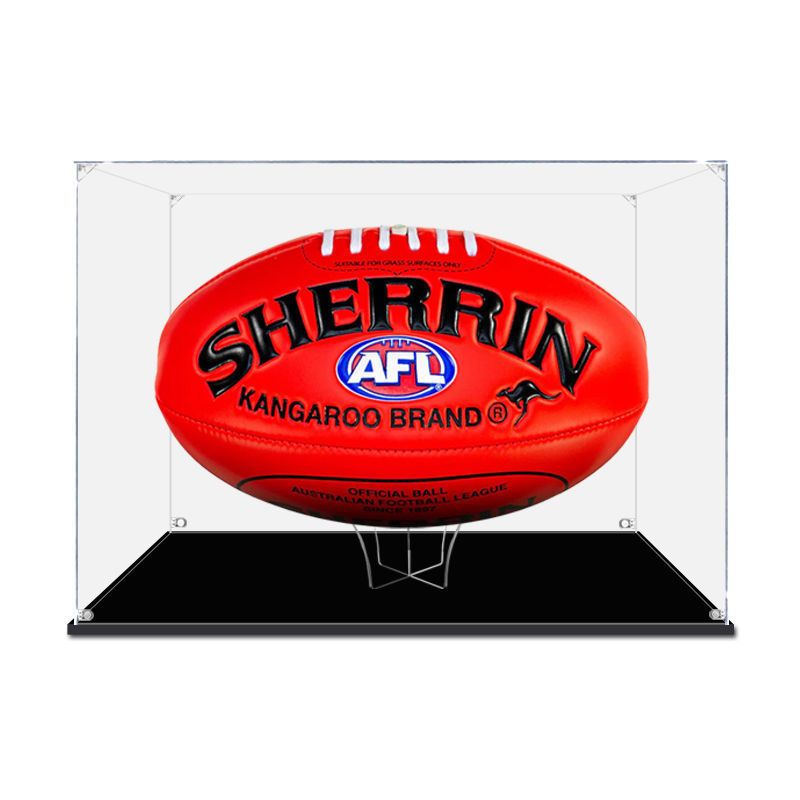
A Shape Nobody Else Plays With
Rugby league has Steeden. Rugby union has its own ball, closer in shape to the original Sherrin was handed back in 1880. But the elongated, indented profile Sherrin actually built has never been copied by any other code, in any country. Spot one from across a room and there's no guessing what sport it's from. That's rare in modern sport, and it's a big part of why match balls and signed balls hold up as collector pieces the way they do — there's genuinely nothing else that looks like it.
If it's a rugby ball you're framing rather than a Sherrin — a rugby union match ball, a signed piece, a milestone-game keepsake — the same case works. It's built to the same oval profile either code uses, just without the AFL-specific indent.
Display It Properly
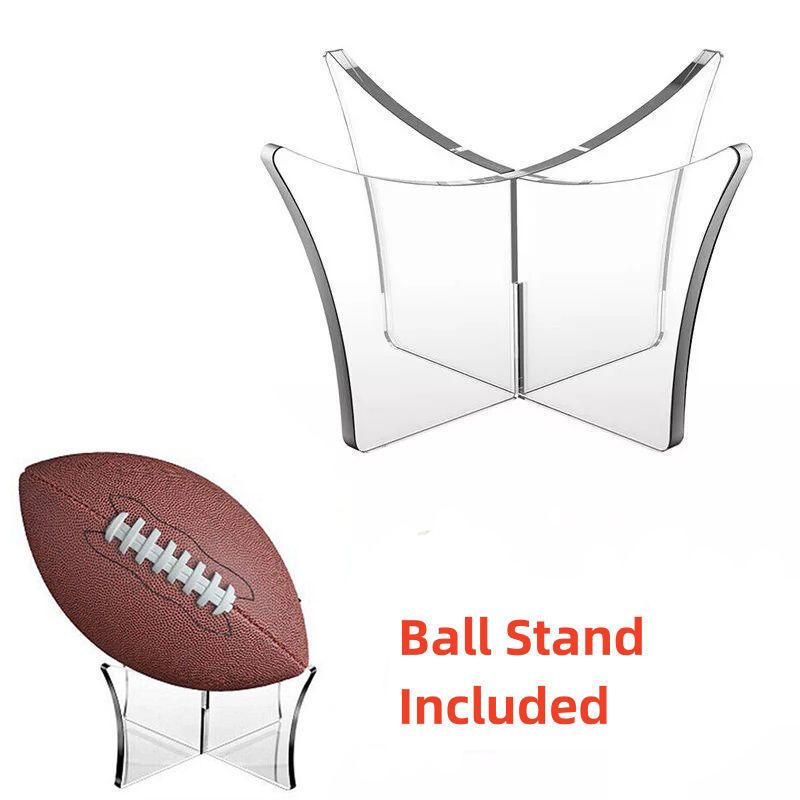
Our Acrylic Display Case is dust-proof and glue-free, shaped and sized for an oval football rather than a round ball, and comes with a stand included.
Features
- Crystal-clear, high-quality acrylic plates
- Dust-proof, fully sealed design
- No screws needed — easy assembly
- Comes with a ball stand included
- Approximate internal size: 33 × 20 × 24 cm, shaped for an oval football
- Suitable for Sherrin/AFL match balls and rugby union balls, signed or otherwise
Frequently Asked Questions
Does the case come with a football?
No — this is the display case only. Balls are not included.
Does it fit rugby balls as well as AFL footballs?
Yes. At 33 × 20 × 24 cm, it's shaped for an oval football generally, so it suits both Sherrin/AFL balls and rugby union match balls.
Is it difficult to assemble?
No — it's glue-free and screw-free, designed for easy assembly with no tools required.
Will it protect a signed ball from fading or dust?
Yes — the sealed acrylic case keeps dust and everyday handling away from the ball and its signature.
Is a stand included?
Yes, a ball stand is included in the package, along with a user manual.
145 Years, One Shape
Every Sherrin that's ever been kicked traces back to a repair job that turned into a redesign. If yours has a signature on it, or it came from a game that mattered to you, it's earned better than a cupboard.
CLICK HERE TO BUY THIS DISPLAY CASE
